This reflective article provides an account of Mukoni’s well-researched book, which unearths and records names that have somehow been forgotten, such as Sally Motlana, in the proper books of history. I think the former President Thabo Mbeki is correct to say, ‘This book is itself a school, which, especially the young generations, should not miss’.
In his book “Faith & Defiance: The Life of Sally Motlana”, published in December 2025, author Mukoni Ratshitanga adds to the list of African biographies that tell the revolutionary stories of unsung heroes and heroines, including Sally Motlana. Notably, this unsung heroine of the liberation struggle in South Africa is well known as a staunch Christian, a defiant anti-apartheid activist, and a midwife of social transformation and community development.
She was born in 1927 in a village called Moremela in the then Eastern Transvaal, now known as Mpumalanga province. In the early 1930s, she moved to Vrededorp in Johannesburg with her mother and later relocated to Sophiatown. Notably, Mukoni does not merely mention the places in the book; he provides their historical origins, their significance in the liberation struggle, and how they shaped and nurtured Motlana’s worldview and consciousness.
For instance, Ratshitanga reveals that, with the assistance and support of conscious priests of liberation theology, such as Trevor Huddleston, who established the Union of South African Artists, and many others, Sophiatown-produced revolutionary leaders and musicians, such as Jonas Gwanga and Hugh Masikela, kept the flame of revolution burning through their songs.
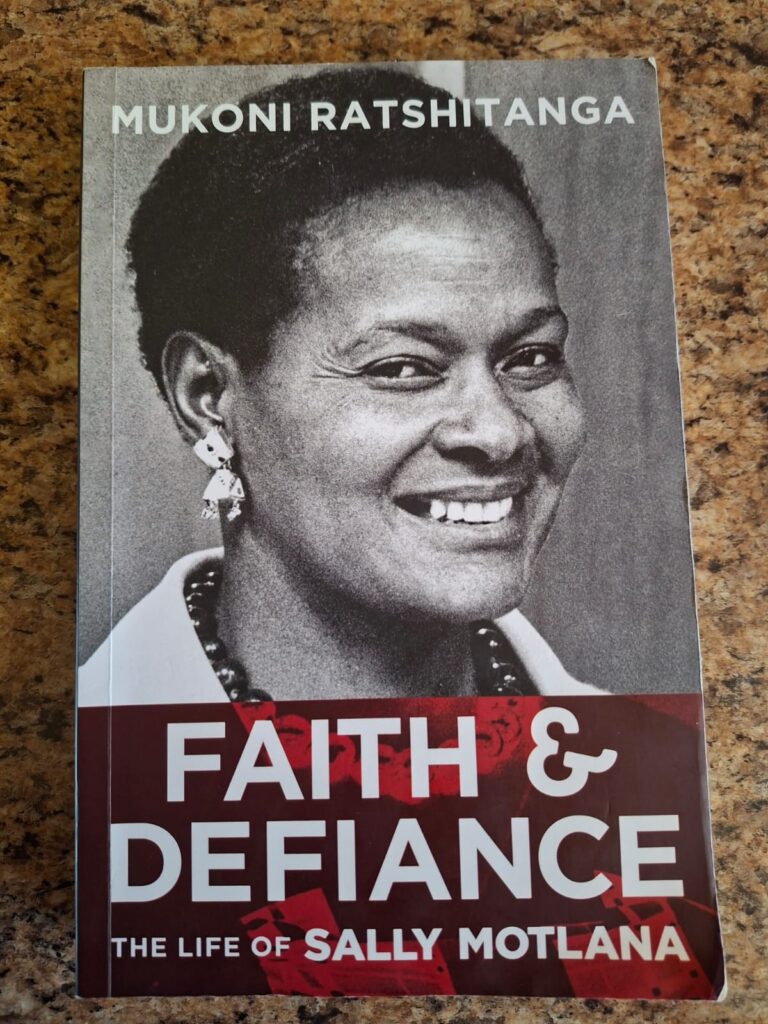
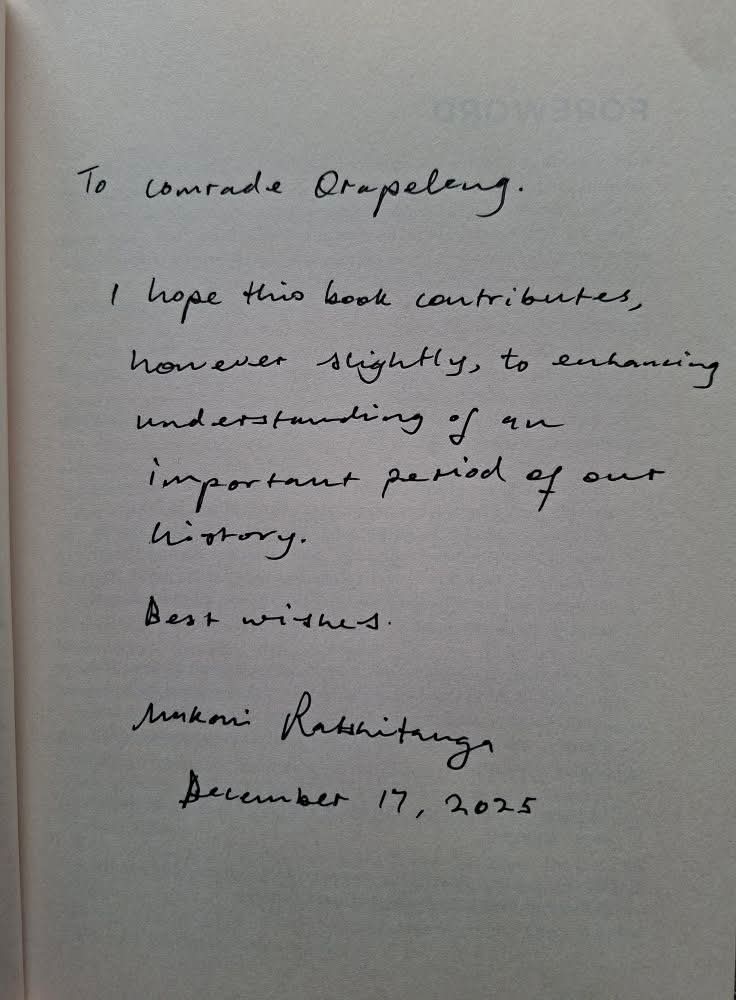
Through the burning ink, readers can learn how the Anglican and later Methodist churches influenced Motlana’s commitment to community development and caring heart for the poor; during the liberation struggle, churches played a critical and active role in mobilising and financially supporting community initiatives. In my view, we need to resuscitate the 1960s spirit of liberation theologians so that the role of the church is repurposed in the contemporary context to produce contingents of active, not passive, citizenry.
One of the valuable lessons I learned from the book is that Motlana was an exemplary intellectual who believed that, for one to be the best leader, one must acquire knowledge, be a community activist and a midwife of social transformation, so that one can be practical rather than keep on theorising about the challenges facing the marginalised and impoverished masses.
The author correctly tells us that Sally’s father named her Bampifeletseng (why do they hate me). This name reflected her father’s pain after Motlana’s maternal grandparents refused to allow him to marry her
mother. In this Africa month, I want to remind Africans that our ancestors used to name children at birth to record family history and give meaning to situations.
I contend that, in his efforts to narrate the evolution of Motlana’s consciousness and activism, Mukoni has provided an objective account of the roles played by various political formations, especially the African National Congress (ANC) and the Pan Africanist Congress (PAC), the South African Communist Party (SACP), trade unions and others, in the liberation of South Africa from the yoke of the oppressive apartheid government.
I think the author has brilliantly articulated how, during the time of Motlana and others as students, Fort Hare University, which is now facing a credibility crisis, was a true microcosm of society and a theatre of revolution, and produced great leaders for the African continent. This was possible because the ANC, working with the broader contingent of the alliance, mastered and managed strategic deployment, drawing on some of its brilliant and qualified minds, such as Professor Zachariah Keodirelang Matthews, to occupy influential positions within the institution. For leaders such as Walter Sisulu, the university was an easy platform for political education and for the ANC to influence the curriculum and policies. Today, some universities are led by reactionaries who are hell-bent on silencing critical voices and promoting colonial epistemologies as the only alternative anchor for knowledge production. Motlana viewed Fort Hare University as a reservoir of politics and argued that ‘if you went to Fort Hare and came out un-politicised there was something wrong with your mentality’.
However, it is worth noting that when she was at the university, she refused to subscribe to communism. At some point, she wrote a letter to the then secretary general of the ANC, Walter, accusing one of her comrades, Joe Methews, of trying to impose communist ideology on her. Apparently, the former secretary general of the ANC, Duma Nokwe, was also prominent in teaching Marxism to students at Fort Hare University.
Apparently, Motlana was told by the Chirwa brothers and the late Mangusuthu Buthelezi that ‘communists were not good’. Sisulu, with her level-headed approach to issues, responded maturely to Sally, saying, ‘You people (comrades) must work together because what we have to do is too much and too important for quarrels.’ The brain of the unifier, the cool, level-headedness of Walter Sisulu, is needed to manage the current contradictions among the alliance partners. The current situation does not need the Buthelezi and the Chirwa brothers, who do not understand that ‘communists and nationalists could co-exist and together wage the struggle against apartheid’, to multiply as peddlers of divisions.
Mukoni should be applauded for uncovering and narrating the prominent role that young and older women, including Motlana and her generation, played during the 1976 ‘Soweto Uprising’. Sally had a Sizwe store in Soweto at the time, which served as a refuge for injured and hungry students. This book dispels the notion and narrative perpetuated by some historians who have ignored women’s role in the liberation struggle. She worked with everyone, including ordinary and prominent women leaders, as well as men who supported women’s empowerment within the broader liberation struggle.
From the book, I learned that Sally was a teacher and an all-rounder; she understood that, as a teacher, you must pay close attention to your learners. She could identify and intervene with a learner who had an eye problem. In 1954, she resigned from the teaching profession after the apartheid government introduced Bantu education. As a conscious revolutionary, she was not prepared to be a transmitter of knowledge designed to damage the mind of an African child.
Motlana established many community-based organisations to empower women and black communities. She served as a prominent figure, as President of the Black Housewives League of South Africa, and as Vice President of the South African Council of Churches, using these positions to fight against the unjust laws of the then-brutal regime. She was brutalised and arrested several times, but she never wavered in her conviction that black people are equal human beings who deserve to be treated with respect and dignity.
In 1981, when food prices rose, Motlana stood up for people experiencing poverty and called for the General Sales Tax (now known as VAT) to be removed, as it was a burden on them. I argue that, in the current and disheartening economic situation, with increases in the fuel levy and food prices, we need many leaders of Sally Motlana’s calibre to be the voice of the voiceless.
Sally Motlana passed away in June 2023. At her burial, Thabo Mbeki said he was saddened but moved by her usual honesty and well-known bluntness. Mbeki also cited Motlana’s words from shortly before her departure: ‘The ANC I knew has died, we must start anew to build it.’ In one of her interviews in the book, she expressed concern that the revolutionary and resilient structures they had established during apartheid, which could have sustained agency and momentum in the post-1994 period, had been destroyed.
Orapeleng Matshediso is a Research Fellow at the University of Johannesburg (Institute for Pan-African Thought and Conversation).


